


Advanced Search
Dress Up | 1st Person | African American Map | Now Read This | Magic Lens | Tool Videos | Architecture | e-Postcards | Chronologies
Ray Elliot - 1917-1939: Ray's early life and his father's participation in the Great WarRay Elliott was born to Marie Davis Elliott and William S. Elliott on February 18, 1924. His family was one of only two or three black families living in his Cambridge, Massachusetts, neighborhood. As he grew, Ray remembers feeling as though he fit into neither a white world nor a black one... Learn more about Ray Elliot: View a timeline of his life and listen to his full interview. Stories by this speaker
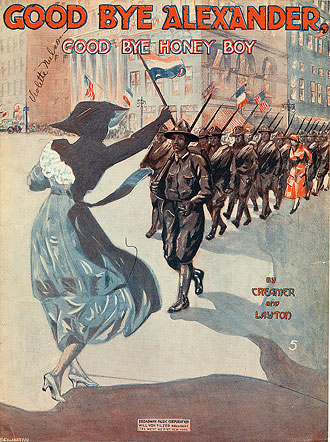
Good Bye Alexander, Good Bye Honey Boy is a World War I era tune which starts, "Alexander Cooper was a colored trooper with his regiment he marched away." The cover illustration of the sheet music depicts France as a woman waving a French flag and leading a procession of black American troops. Like much of America at the time, the United States Army was segregated, meaning that black soldiers and white soldiers were made to serve in separate units. In fact, only a fraction of the 380,000 black men who served in the Army during World War I were involved in combat. More typically, black soldiers performed manual labor for the Army, building the bridges, roads, and trenches that were essential to the war effort. Ray Elliott's father was one of about 42,000 black soldiers who served as infantrymen, often with distinction, under the leadership of French officers and beside French soldiers. Sheet music for Good–bye Alexander, Good Bye Honey Boy composed by Creamer and Layton, c. 1918. Cover illustration by E.E. Walton, collection of Reba–Jean Shaw Pichette. 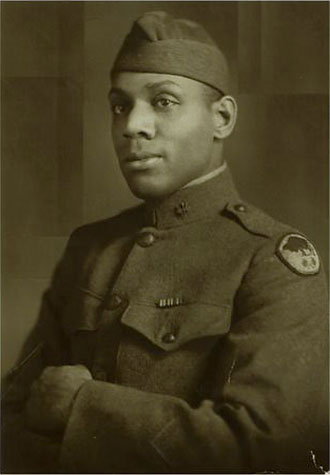
This is a portrait of Ray Elliott's father, William S. Elliott, who was a member of the 92nd Division during World War I. He wears the "Buffalo Soldier" insignia of the 92nd Division. 
A silhouette of a Buffalo dominates the shoulder sleeve insignia of the 92nd Infantry Division. A similar patch can be seen on William Elliott's uniform. The 92nd Division, as Ray explains, "inherited the legacy of the Buffalo Soldier." This legacy reached back to the Army's 10th Cavalry Regiment of black soldiers who fought in the American Indian Wars during the nineteenth century. Ray tells us that, "the Indians named them the Buffalo Soldiers because their hair was curly and kink...similar to the coat of the buffalo. And the skin of the buffalo was brownish, similar to that, and they were furious warriors, tremendously well–respected by the Native Americans as being tremendous warriors" The motto of the 92nd Infantry Divisions' Buffalo Soldiers was "Deeds, Not Words." The regiment as activated in October of 1917. The 92nd Infantry was reactivated during the Second World War. Photograph of Ray Elliott's father, collection of Ray Elliott. US Army 92nd Infantry Division Shoulder Sleeve Insignia, Public Domain. 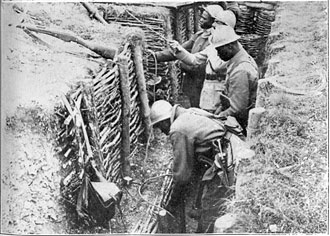
This is a photograph from Scott's Official History of The American Negro in the World War. According to its caption, "Here is a photograph right from the front, an unusual picture showing how the trenches really looked. These are American and French colonial colored soldiers in a French trench." The Buffalo Soldiers fought in the Meuse–Argonne Offensive which occurred in France's Argonne Forest in the autumn of 1918. It was the final battle of World War I. Allied British, French and American forces won the Battle of the Argonne Forest early in November, but not before an estimated 26,000 American soldiers lost their lives. Ralph W. Tyler, the "Only Accredited Negro War Correspondent" of World War I wrote this report on the final day of the war: Somewhere in France, November 20. They were in it at the finish, as they were at Verdun, Soissons, Chateau–Thierry, Argonne and Champagne. At the eleventh hour on the eleventh day of the eleventh month in the fifth year of the war, when the signal flashed from Eiffel Tower in Paris stopped hostilities, in conformity with the terms of the armistice just signed by the Germans, the 92nd Division, composed of Colored American Soldiers, occupied the point closest to the German city of Metz, the objective of the last drive of this war. At the stroke of eleven the cannon stopped, the rifles dropped from the shoulders of our Colored soldiers, and their machine guns became silent. Then followed a strange, unbelievable silence as though the world had ceased to exist. It lasted but a moment—;lasted for the space of time the breath is held. Then, among these dark–skinned troopers came a sigh of relief—;came jubilance, as every colored soldier, in true Parisian vernacular, exclaimed: 'La Guerre est fini'—;the war is over, and immediately thoughts turned to dear ones back across the sea, while tears flowed down their war–grimmed black faces for the hundreds of comrades bivouacing forever in sepulchers over here in France...1 Courtesy of the World War I Document Archive Web site. Footnote 1. Emmett J. Scott, Scott's Official History of The American Negro in the World War (1919), 285–6. Courtesy of the World War I Document Archive Web site, (http://net.lib.byu.edu/estu/wwi/comment/Scott/SCh20.htm) retrieved April 23, 2009. 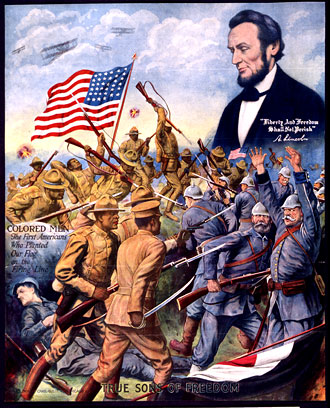
This poster, created in 1918 by illustrator Charles Gustrine for the Committee on Public Information, suggests the nation's appreciation for the courage and patriotism of African American soldiers during World War I. In contrast to this public acknowledgement of the important role that African Americans played during the war, in actuality, the Army took a more complicated stance toward black soldiers. The same year that this poster was created, General John Pershing, head of the American Expeditionary Forces wrote a document outlining the Army's expectations for how African American soldiers should be treated by the French Military. This document, titled Secret Information, points to the tenuous place that blacks held in American society. "We must," explained General Pershing: prevent the rise of any pronounced degree of intimacy between French officers and Black officers. We may be courteous and amiable with the last but we cannot deal with them on the same plane as white American officers without deeply wounding the latter. We must not eat with them, must not shake hands with them, seek to talk to them or to meet with them outside the requirements of military service. We must not commend too highly these troops, especially in front of white Americans. Make a point of keeping the native cantonment from spoiling the Negro. White Americans become very incensed at any particular expression of intimacy between white women and black men. General Pershing's directive did not remain secret, and in May of 1919, its contents were published in the African American magazine The Crisis. "Returning Soldiers," written by black leader W.E.B. Du Bois appeared in the same issue. "We stand again," exhorted Dubois: to look America squarely in the face and call a spade a spade. We sing: This country of ours, despite all its better souls have done and dreamed, is yet a shameful land...We return. We return from fighting. We return fighting. Make way for Democracy! We saved it in France, and by the Great Jehovah, we will save it in the United States of America, or know the reason why. Charles Gustrine, "True Sons of Freedom" Color–offset poster, Chicago, 1918. Library of Congress, Prints and Photographs Division, WWI Posters, LC–USZC4–2426. Story Clip #1:"One foot in one culture, one in another": Growing up in Cambridge, Massachusetts Wait for each file to download, then click the arrow to play the audio. I was born in Cambridge in, uh, February 18, 1924, and at, at that time, just before the uh depression...or no...yeah, prior to the depression, my dad worked in the post office and my mom was a, a registered nurse. She was working in various hospitals. Uh, and uh, so we didn't really feel the pressures of the depression, ah because they uh were doing quite well. And uh, we grew up in a part of the community that was mostly...predominantly white. There was only two or three black families in the community area. And so I didn't have the advantage of being able to live in a black community to, you know, to actually be able to feel the uh, the black culture or to grow up in the black culture. Ah...and so I really wasn't accepted, uh, in the, in the white community, and yet when I tried to uh socialize in the, in the black community, uh, they felt that I wasn't, uh, what they might say, "black enough." I was not uh, uh, born in the "hood," or in the black culture. So I wasn't accepted in either one of the commun...uh...cultures and so I had one foot in one culture and one foot in another, and this was a very, very disturbing thing for me because of my...uh, you know, learning my identity, you know, who I was. Story Clip #2:"No...white commander wanted to be in charge of black troops": Ray's father serves in World War I "Growing up, my dad never spoke about his experience...uh...in the first world war. And uh, so we never knew much about him until later on...uh...in my, in my life. NM: So he didn't talk a lot about...he had served in the war before you were born. RE: Oh yeah, he served in the first world war, and he was uh, in the 92nd uh...Regiment...which form...which fought in France, uh, under the French government. And that was a disturbing thing when I found out that it was a time when, uh, no commander, uh, American commander, white commander wanted to be in command of black troops. Uh, they felt that they weren't good warriors and uh, and not good fighters, so...the French government took them under their command, and uh, it was, it was very exciting the fact that his regiment did co...they performed so meritoriously that the French government awarded them, the regiment, the uh...the highest honor, uh medal of honor, the Croix de Guerre, uh, which is the medal of war. And uh I didn't know about the fact that also that my dad was, was part, well, actually they had inherited the uh, the legacy of the Buffalo Soldiers. And I didn't discover this until I saw a picture of him and on his shoulder patch was a patch...of the buffalo soldier, uh...patch and I didn't discover that until just recently. And, uh, so he was a uhhh....referred to the...92nd referred to the uh, uh...buffalo soldiers also. Story Clip #3:"The legacy of the Buffalo Soldier" "The significance of the Buffalo Soldiers was that ah...back in um...after the war, there was a regiment that was uh...the cavalry that was formed, a black cavalry, and this cavalry was assigned to the, the midwest...western frontier, to uh, to fight the uh, the n...uh, in the western frontier primarily in uh the Indian?American Indian Wars that were taking place. And the Indians named them the Buffalo Soldiers because their hair was curly and kink...similar to the, to the uh, the coating...the coat of the buffalo. And the skin of the buffalo was brownish, similar to that, and they were furious uh...uh warriors, tremendously well–respected by the Native Americans as being tremendous warriors, and that's why they named them the Buffalo Soldiers. And then when they uh, uh...when the cavalry was dismounted, dismantled, uh, the 920...the 92nd and 93rd were black, all black segregated regiments in the army, and so they inherited the legacy, the legacy of the Buffalo Soldiers. So it was passed down to them." Story Clip #4:Ray's father co–founds the Isaac Wilson Taylor Post of the Veterans of Foreign Wars in Cambridge, Massachusetts "when he came back to this country, uh, he and his buddies wanted to join the Veterans of Foreign Wars. But they weren't welcomed that much, you know. It was a time when, when there was this uh...racial attitudes of separatism. And uh, and so, they made it difficult for them to...to...to be members and so my dad and uh, a uh, another friend, they formed a first black Veterans of Foreign Wars, uh, post in Cambridge. That was in I forget the year. But anyhow, it was called the Isaac Wilson Taylor Post. It still exists, and he was made...my dad was made first president of the Isaac Wilson Taylor Post. And my mom, she was made the, uh, first president of the Ladies Auxiliary uh, po...post...part of the post. And uh, so this was very exciting, but it left a bitter taste in my mouth about, uh, the way the country had, you know, not welcomed him with open arms back, when he came back from service, and uh, and so I always try to to, uh, find out more and more about uh what he went through, but I came to the the conclusion that perhaps the reason he didn't speak about it is 'cause he...probably was suffering from what is very common today with troops, post traumatic stress syndrome, 'cause he showed some signs of it, 'cause they experienced such severe war experience." Story Clip #5:The most important thing anyone can learn...to have compassion and love for another human being": his mother's influence "my mother...I didn't know, but since 1930, I think in thirty–two or so, she...she had been...we had a uh...she had for...started a nursing...rest home, a nursing home. And she used to take people in that couldn't afford to go to white nursing homes. And she only charged them what the state would pay the poor people, which was very minimum. And, and I remember, uh...how she used to help the neighbors uh...when they had illness or sickness. She would go to the different...they'd call her and ask her to come over...so–and–so is ill, and she wouldn't charge them. She serviced the whole community in many different ways, and uh...I was too young to appreciate it. And she still had that nursing home for many years. But, uh...she taught me of caring for people, how important it was to love another human being. And therefore, to me, that's the most important thing that I...anyone can learn...is have compassion and love for another human being, and uh...she demonstrated it. So, to me, she's my hero." Related ResourcesThe following source file was not found: ebdav/centuries/html/resource/elliot1917.html
|
    |
Home | Online
Collection | Things To Do | Turns
Exhibit | Classroom | Chronologies | My
Collection
About This Site | Site
Index | Site Search | Feedback