|
(c) Pocumtuck Valley Memorial Association, Deerfield MA. All rights reserved.
Struggle for Freedom : "Run-away from his Master"
|
|
European and American society in the early eighteenth century was essentially hierarchical. The amount of freedom people had depended upon their status. That status in turn depended upon the degree of economic and political authority they or their families wielded. Slaves were the least free members in a world of unequal and coercive relationships. The landless laborer, even the lowest ranking servant, possessed a degree of personal freedom denied to slaves.
The status of the first involuntary African immigrants in the 1600s at first differed little from that of the white indentured servants who outnumbered them. By the end of the century, however, legal documents began using the phrase "servants for life" to distinguish slaves from indentured servants. Laws defined slaves as a kind of property. And, most importantly, slavery as it developed in America was confined to people of color and their offspring.
Tens of thousands of newly enslaved Africans poured into England's American and West Indies colonies in the eighteenth century. Most of these newcomers lived and labored under the most wretched conditions imaginable, especially those condemned to labor on the sugar plantations of the West Indies or on the rice and indigo plantations of South Carolina. The death rate in these areas was so high that only constant imports of still more thousands could maintain and increase their black populations.
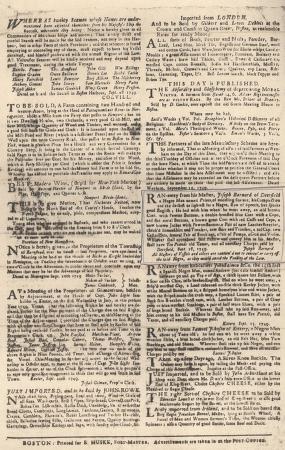
Meanwhile, slaves made up only about four percent of the total population of New England. Most northern masters owned no more than one or two slaves. Their relatively small numbers and geographic dispersion made group insurgency against slavery difficult for northern blacks. There exists evidence, however, that many slaves resisted white masters and the slave system in general. Newspapers reported incidents of poisonings, arson and other forms of resistance. The runaway slave announcements in this Massachusetts newspaper from 1749 reveal the presence of African Americans in rural as well as more urban areas. Such notices also provide proof of the most obvious form of individual resistance to slavery: running away.
top of page
|
Advertisement in "The Boston Weekly Post-Boy" newspaper
| publisher Boston Weekly Post-Boy |
| creator Joseph Barnard (1717-1785) |
| date Oct 2, 1749 |
| location Boston, Massachusetts |
| height 12.0" |
| width 8.5" |
| process/materials printed paper, ink |
| item type Periodicals/Newspaper |
| accession # #L99.174 |
|





